by John Byrne Barry | Feb 24, 2015 | Bones in the Wash
I hosted a book launch a year ago today in Berkeley for Bones in the Wash: Politics is Tough. Family is Tougher.
My first book, my first launch. Pretty exciting. And nerve-wracking.

More than 50 people showed up—standing room only—and though most were friends and family, there were a few strangers in the mix, which was heartening. (It helped that the Mo’ Joe Café, where we did the launch, was a block from where I lived for 25 years and walking distance for a bunch of my friends.)
My friend Bob Schildgen, author of Hey Mr. Green, served as M.C. and read a passage. My wife Nanette and my son Sean also read excerpts. I delivered a brief intro about how I came to write the book, read a few pages, and answered questions.
I was thrilled with how well it went—it felt like a smash success. (Scroll down to see some photos.)
I even ran out of books to sell. I sold 22 books, including the one I was reading from, which had a couple of pencil marks. (I thought I would be tempting the fates if I came to the launch with too many books.)
That book launch was my single best day for selling the book, but sales since have been disappointing. A year later, despite continuing to get positive response and reviews, I can sometimes go a month without selling a book. I did a better job writing my novel than I have marketing it, but I believe that even if I were a marketing superstar, it would be an uphill climb.
I expected that marketing my self-published first novel would be hard, and I was right about that. I thought, however, that I had managed my expectations pretty well. Looking back, even my modest projections seem overly ambitious.
The actual publishing wasn’t too hard—I mean, other than rewriting the book a dozen-plus times and incorporating suggestions and corrections from many readers and editors. Getting the book formatted for Kindle and trade paperback took at least a month, and a lot of careful proofreading, but it was straightforward.
I am close to completing my next novel, Wasted, a “green noir” mystery set in the world of garbage and recycling in Berkeley. I wrote Wasted before Bones in the Wash, and am now rewriting it one more time. Response so far has been positive—most everyone has enjoyed it and three people said they raced through it in a day or two. That’s what I like to hear. And that was the advance reader copy. It’s now at least 3 percent better! 🙂
My hope is that when I launch Wasted this spring, response will continue to be favorable and maybe I’ll sell a few copies of Bones in the Wash along the way.


More photos here.
by John Byrne Barry | Jan 21, 2015 | Design
OR
From My Kitchen Cabinets to the Russian Far East
Last year, I devoted many months writing and designing the Conservation Investment Strategy for the Russian Far East—which was about, among other things, growing markets for wild salmon in Kamchatka, scientists and indigenous hunters teaming up to monitor walruses in Chukotka for climate change impacts, mobile fire brigades fighting wildfires accidentally set by farmers burning their fields. More fascinating than you might think.
The client, Pacific Environment, was thrilled with the report and I was proud of it too. It’s some of the best work I’ve ever done.
What I found interesting, though not surprising, was that almost all the kudos were about the design, even though that accounted for only a quarter of the work.
That’s probably because most people didn’t read the entire 80 pages. And those few who did appreciated that the design elements reinforced the message of the document.
It’s a reminder to me, as a writer and designer who identifies more as a writer, that in many cases, design is as important or more important than the words.
My plan here is to deconstruct my design process to see if I can learn from what I did, and maybe others can as well. It’s not that I didn’t consciously make decisions along the way as much as that I’ve been a designer for decades and some of those decisions were almost intuitive. Looking back I can see more clearly what I did.

A word about the writing part. There was heavy slogging along the way—I had to distill hundreds of pages of dry scientific language into a compelling narrative, and there were moments when I was pulling out my hair. It’s not that the content I had to work with boring, though some of it was. But it wasn’t exactly high in entertainment value, so one of my goals was for the casual reader to get the basic message from the decks and captions and headlines.
Here’s an example—I didn’t have a photo for this story, but the concept was pretty straightforward, that satellite photos could document pollution much more effectively than a government agent who has to make an appointment to visit the mine.
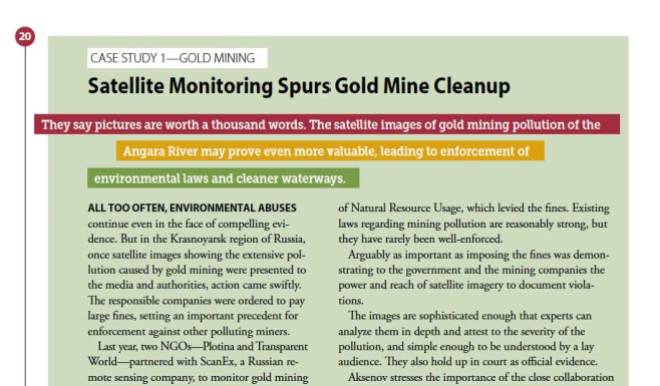
What Do Readers Read?
Photos, of course, play a huge role, not just the images themselves, but the captions, which get read, depending on who you listen to, four times more often than the body text. The best captions reinforcing the message of the document. So, for example, the caption for the photo below of two tigers growling at one another doesn’t reference the photo directly, as much as it provides important context—how there are only 500 Amur tigers left in the wild, but they are on the rebound.

There’s no need for the caption to repeat what the reader can see in the photo.
I also looked for ways to feature people, in the narrative and the images. So much of the content I had to work with was scientific, like the names of threatened species, or fishing harvest data.
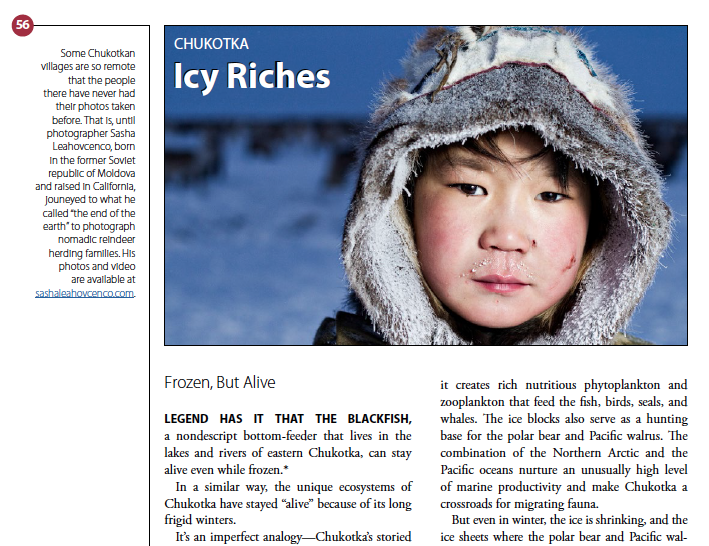
The chapter on Chukotka, which is across the Bering Strait from Alaska, and equally frigid, didn’t have a lot of compelling stories. All of the photos I had to start with were of stark landscapes. None of people. In my search for better images, I came across a wonderful website and story by a photographer from California, Sasha Leahovcenco, who was born in the former Soviet republic of Moldava and journeyed to Chukotka to take photos of indigenous people there, most of whom had never seen photographs of themselves before. He was happy to let me use his photos. Here’s one of my favorites.
Five-Column Grid—It’s Great to Be Odd
Even though I’ve designed dozens of reports like this, I deliberated carefully on what kind of grid to use. Mostly, for reports that are standard 8.5” x 11” size page, I use a simple two column grid, but for something long and complex like this, with maps and photos and charts, I chose five columns, which allows for both uniformity and variation. The default layout was two blocks of text, one two columns wide, the other three. It’s more interesting than two columns the same width.
It also allows for one column of white space when necessary. I found this very helpful for fitting copy. When text was added or cut, and I didn’t want to add extra pages, I could expand or contract the column width and still have a unified look.
Here are two chapter-opening spreads where the left-most column is primarily white space, and the right page uses the 2 + 3 grid. Then comes a text-heavy page with 2 + 3 on both the left and right side.
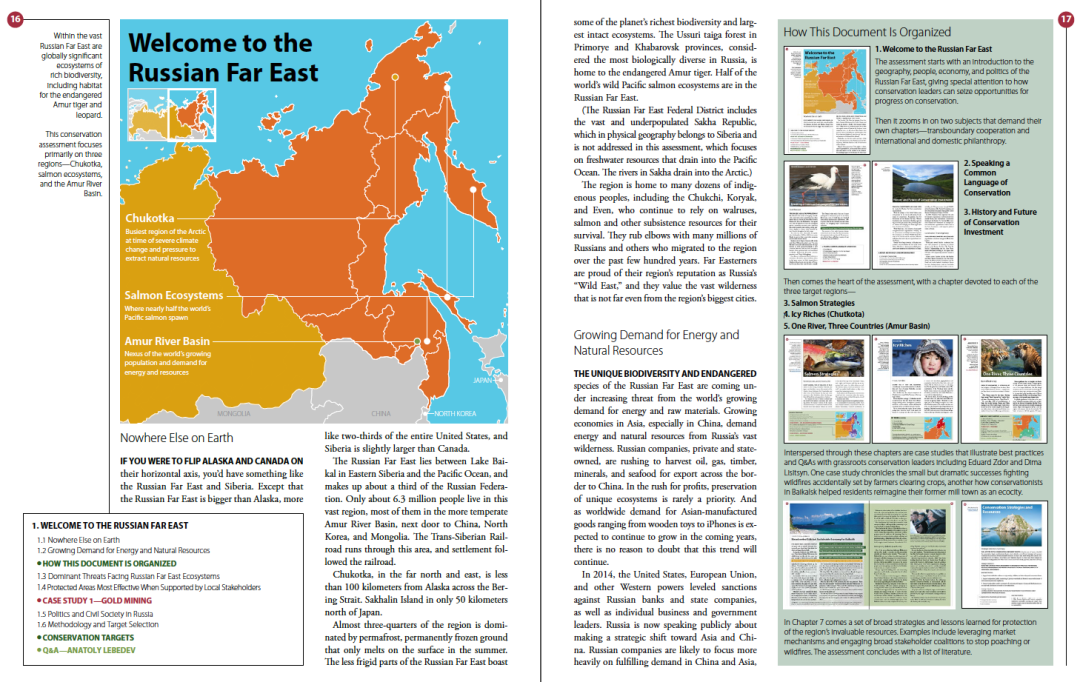

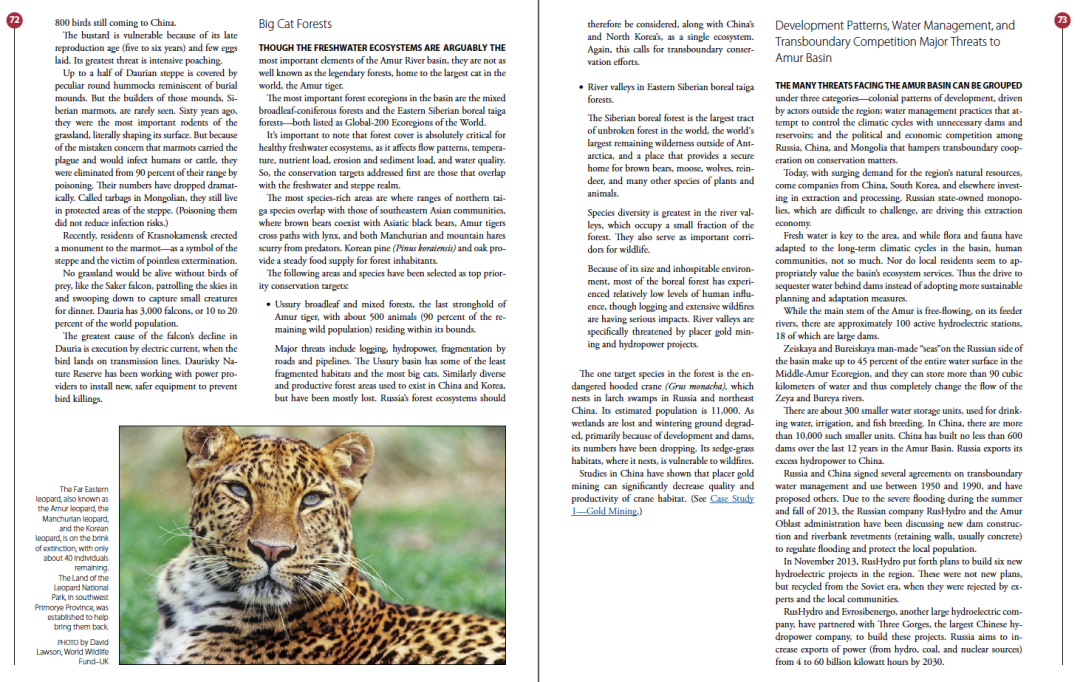 Note also how the map, which is a dominant element in the first spread above, is used on a smaller scale at the bottom of the second spread, as a locator map for the particular region being addressed, in this case, Chukotka. Maps are especially important when readers may not know the area, but even when they do, they help anchor the story.
Another design element that helped orient readers (pun intended) was including a mini-contents box at the bottom of each chapter’s opening page to supplement the map. This was a big and complicated document, and though these mini-tables of contents were redundant to what was in the main table of contents, I wanted to make it as easy as possible for readers to know where they were and what was coming.
Color Bars
Arguably, the most important design decision was to use wide horizontal bars in gold, olive, and rust to feature what I call “decks.” (They are often referred to as “pull-quotes,” but for this project, I more often distilled an important point into a sentence that might been a paragraph in the text.)
Like the grid, the regular use of the color bars contributed to a unified design, but they were even more versatile than the grid.
Because I used the color bars in a slightly different way each time, I was able to use them more than a dozen times without being repetitive. What was consistent was the color palette, the height of the boxes, and the typeface, and what varied was the length and placement of the stripes, and the specific colors. In some cases where there were three lines, I used all three colors. In some cases, all three stripes were aligned on the left. But other times, I staggered them or only used two colors. (In a few places, where I was already using the olive green as a background, I added a fourth color, a darker green to the color bar palette.
Below are a some examples. You can see that the placement, alignment, colors, and length vary, and of course, the words do too, but the palette and typeface keep things unified.
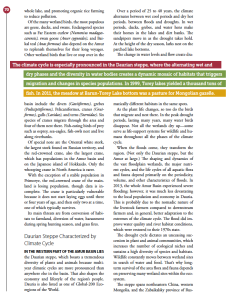
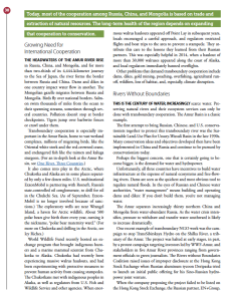
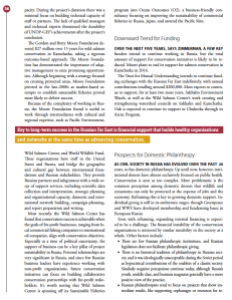
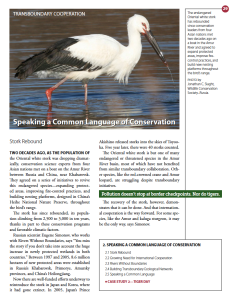
From My Kitchen Cabinets to the Russian Far East
Choosing a color palette is one of the most important parts of a design, and there are almost an infinite number of options.
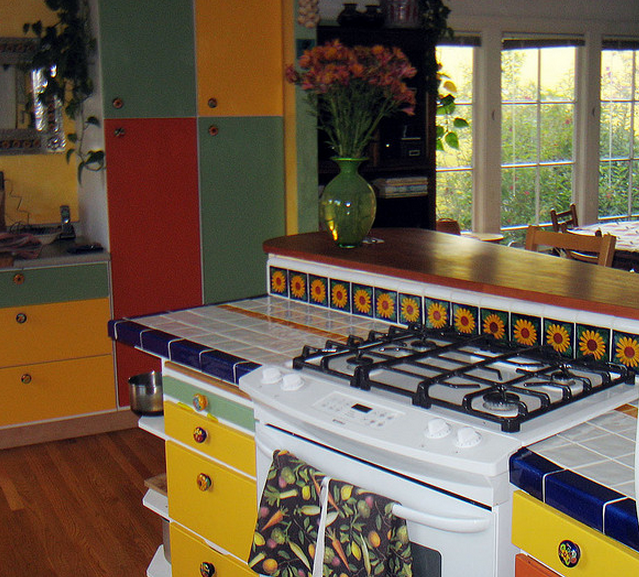
I knew I wanted warm colors to counteract the arctic content. I started with rust, one of my favorites, and before I realized it, I was working with roughly the same colors I painted my kitchen cabinets in Berkeley a decade ago. (I know I can’t keep using the same colors over and over, but recycling a palette every ten years doesn’t seems to be a problem.)
Back around the turn of the century, my kitchen cabinets were medium brown wooden doors and drawers that were becoming increasingly ugly with wear and tear. On a trip to Mexico, I purchased colorful ceramic (Talavera) knobs from street vendors in San Miguel de Allende, and my plan was to paint the cabinets white and add the knobs for color. The first few I painted didn’t look as interesting as I’d hoped.
So I played with some richer, more intense colors, and after some trial and error ended up with three colors—rust, gold, and olive green. You can see the cabinets here.
Reinforcing the Message, Telegraphing the Character
Design that is visually appealing and memorable is a strong start. But not enough. The most critical element of good design is that it telegraph and/or reinforce the message and character of the content. Is it authoritative? Whimsical? Serious as death? Important, but not self-important. In the case of the Russian Far East document, it was important to get across the comprehensiveness of the report. Because the length of the report and the long list of contributors at the beginning already characterized it as comprehensive, I didn’t need to do much more with the design to reinforce that. Instead, my primary design goal was to make the report more engaging and welcoming. The colors and the maps and the intimate closeups of people helped with that.
by John Byrne Barry | Dec 22, 2014 | Bones in the Wash
True confession: I have, more than a couple times in my life, poured over a steamy passage in a bookstore or library because, well, because it was steamy.
I’m not the only one. Some of those passages were in best-selling books.
As a writer, however, sex scenes, steamy or otherwise, are, pun intended, hard to get right.
This fall, I’ve done a couple readings from my novel—Bones in the Wash: Politics is Tough. Family is Tougher—and I devoted some of my time to talking about writing sex scenes.
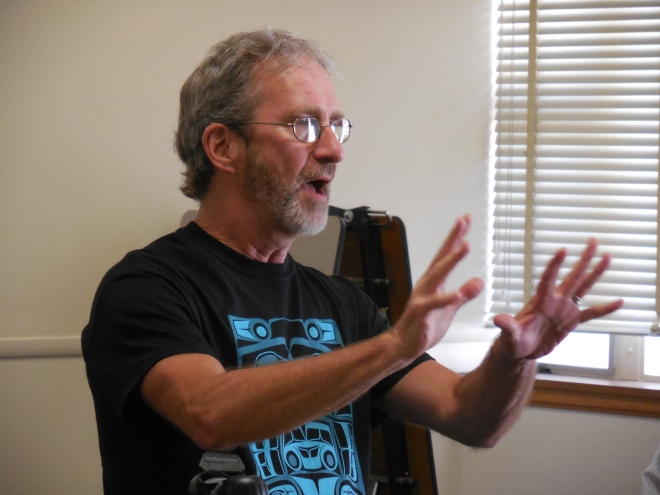
Talking about politics, family, and sex at the Oakland Public Library. Thanks to Tim Jollymore for the photo.
Since there were a number of writers in the audience, I asked for a show of hands of those who had written sex scenes. More than a dozen each time. Then I asked how many were satisfied with what they wrote. Only a few.
I also asked everyone, as readers, how satisfied they were, again, pun intended, with sex scenes in novels. Mostly, not so much.
Which begs the question: why include them? Sure, they’re titillating, and yes, sex sells. But plenty of fun and successful novels are sex-free zones. You could argue that sex is part of most people’s lives, so why wouldn’t it be in novels, but so is peeing, and few authors show their characters going to the bathroom.
Response from readers to Bones in the Wash has been heartening. Reviews have all been positive, some effusively so. But not everyone liked the sex scenes. My wife, for one, and the women in her book group, who discussed the novel one Thursday evening when I found somewhere else to be.
I asked around. One woman friend said several phrases—“ravaged” and ‘his hardness found her wetness”—read like “a cheap grocery store romance.” Ouch! “And take away from the book,” she added, “which I loved.” That was certainly not my intention. It wasn’t just women—one man said the explicit sex didn’t do anything for him.
So I rewrote some of the sex scenes, and uploaded a new version. I think the book is better now, but I’m curious as to what you think. Here’s some before and after.
First, an easy one. This excerpt comes—spoiler alert—after a flash flood has unearthed the bones of protagonist Tomas Zamara’s long-disappeared wife Vera in a wash outside Santa Fe.
| original |
revised |
| Tomas was not interested in making love, and Tory didn’t tease him or touch him suggestively like she often did. But in the middle of the night, in the moonless darkness, they found each others lips and his hardness found her wetness and they moaned together in two-part harmony before falling back to sleep. In the morning, the sky was bright and the sun was blue. |
Tomas was not interested in having sex and Tory didn’t tease him or touch him suggestively like she often did. But in the middle of the night, in the moonless darkness, they found each other’s lips and made love slowly, tenderly for a few minutes before falling back to sleep. |
Better, right? What was I was thinking? Was I thinking?
Here’s another, from a few chapters earlier. Tomas lived in Albuquerque and Tory in Santa Fe, so on their first several dates, he did a lot of driving. So she suggested on their next date, they do a “sleepover.” No sex, but he wouldn’t have to drive all the way home.
| original |
revised |
| He expected they would make out a little, but sleepover, to him, implied sleeping. Tory had other ideas. She leaned into his chest. “I love to snuggle,” she said.
She didn’t so much attack him with her kisses, as pull him towards her. Welcoming him. It had been a long time.
He reached under her nightshirt. No underpants. Wet. She wriggled into his finger and purred as he rubbed her. She nuzzled her nose to his. “You tricked me,” she said. “You know exactly what you’re doing.”
After she came, she took him in her mouth, and oh Jesus Christ, how is this happening? |
He expected they would make out a little, but sleepover, to him, implied sleeping. Tory had other ideas. She leaned into his chest. “I love to snuggle,” she said.
She didn’t so much attack him with her kisses, as pull him towards her. Welcoming him. It had been a long time.
He reached for her. She nuzzled her nose to his. “You tricked me,” she said. “You know exactly what you’re doing.” |
That was simple. Just take a few sentences out. Then, in the morning:
| original |
revised |
| He slept, and woke at daybreak with a throbbing erection.
Nothing unusual about that, except that here he was in bed with Victoria Singer, Hurricane Tory, her calf resting on his ankle.
She opened her eyes, yawned, then smiled.
“Hi.”
They kissed, dozed, kissed some more. And then, suddenly awake, he found himself straddling her, his arms rigid, elbows locked, their heads at the foot of the bed, her unkempt hair spilling over the side. She held him between her fingers and guided him towards her, dipping him in her juices. Knocking at the door. Full of anticipation and desire.
She was so present, her eyes, bright and playful, locked onto his. Her smile beguiling. Then she crossed a line from delight into a focused intensity. She was hardly breathing. He was hardly breathing.
Then he slipped in. Plunged in. Quickly. Deeply.
Did she take her hand away? Draw him in? Was there permission there? Or did—?
He pulled out. Broke from her gaze.
When he looked up again, she had that same intent and lustful look, and didn’t look concerned at all. “A preview,” she said, and then her face relaxed into a grin. As if in slow motion. “Lovers don’t finally meet somewhere. They’re in each other all along.”
“Rumi?”
She nodded.
“Aren’t most previews more than a few seconds?” he said.
“You’re the one who pulled out.” |
He slept, and woke at daybreak with a throbbing erection.
Nothing unusual about that, except that here he was in bed with Victoria Singer, Hurricane Tory, her calf resting on his ankle.
She opened her eyes, yawned, then smiled.
“Hi.”
They kissed, dozed, kissed some more. And then, suddenly awake, he found himself straddling her, his arms rigid, elbows locked, their heads at the foot of the bed, her unkempt hair spilling over the side. She held him between her fingers and guided him towards her, dipping him in her juices. Knocking at the door. Full of anticipation and desire.
She was so present, her eyes, bright and playful, locked onto his. Her smile beguiling. Then she crossed a line from delight into a focused intensity. She was hardly breathing. He was hardly breathing.
Then. Then. Did she take her hand away? Was there—?
When he looked up again, she had that same intent and lustful look.
“A preview,” she said, and then her face relaxed into a grin. “Lovers don’t finally meet somewhere. They’re in each other all along.”
“Rumi?”
She nodded.
“Aren’t most previews more than a few seconds?” he said.
“So I’ve heard.” |
Again, the same scene, with fewer explicit words. Better? Is less more? I thought so before. Now I’m not so sure. Or I could have cut more.
Are these minor “improvements” worth all the teeth-gnashing? It’s hard to know. (Though I think eliminating the word “ravage” from my vocabulary is a no-brainer.)
Let me go back to the question I asked above: Why did I include sex scenes?
(btw, we’re talking about five, six pages out of 400. Most of the book is not about sex.)
For me, the answer is because they reveal character.
Sex is something universal that just about all adults engage in, but because it’s private, emotionally charged, and the participants are exposed and vulnerable, it shows who people are in ways nothing else does. There’s also plenty of religious and cultural baggage associated with it, and that can add richness and texture. And because sex is private, readers tend to be curious about how other people, fictional or not, do it.
The best sex scenes aren’t necessarily the steamiest. Great sex doesn’t make for a great scene. What’s often more interesting is when things go wrong. Where instead of ecstasy, the lovers experience distress or embarrassment or loneliness. Which they usually keep to themselves.
by John Byrne Barry | Dec 8, 2014 | Bones in the Wash
One of my favorite reviews of Bones in the Wash is from my brother Michael, an English professor at the University of Detroit-Mercy. He may not be objective, but he does study and teach novels for a living. So that’s something.
(There are 67 other reviews if you want some less familial takes.)
Well-crafted, Thoughtful, and Fun
I know the guy who wrote this too, and have known him for a while. He is my brother. I was reading the book while traveling this summer, so I’ll start with one story of reading while on the train and one of reading while on the bus. I got more and more embroiled in the plot as I got further into the book, so I wasn’t paying much attention to my surroundings. And when I was within four paragraphs of finishing, my stop on the Chicago el train was coming right up. The train stopped and I had three paragraphs to go. Things in the book were pretty well wrapped up, but I wanted to see just how it ended. By the time the doors opened, I had one paragraph to go. I kept reading, finished, and dashed out the doors just as they were closing.
The day before, I was next to a guy on the bus, and I was talking about the book. I teach literature, so it’s a pleasure for me to talk about books. He was a reader, so he told me about Philip Roth and I told him about John Byrne Barry. Anyway, he said “Well, it must be awkward, you being an English professor and him wanting to know what you think of the book.” And I laughed and said it wasn’t awkward at all; the book was so good I didn’t need to worry about that for a second.
I like the book’s stories of trying to do the right thing in the context of hard-ball politics. It reminded me of Robert Penn Warren’s All the King’s Men that way — there are times when one of the main characters, an earnest young woman who wants to bring about political change, wonders whether it would be a morally just course of action, in the long run, to dig up dirt on her opponent’s campaign manager (who is another of the main characters), to discredit him and win the election for the candidate whom she genuinely believes occupies the moral high ground. There is a meditation on how we can know enough about the consequences of an act to judge whether it’s good or bad (good news? bad news? who knows?), there are references to the temptations of political office, temptations to take care of your people.
Mayor Tomas Zamara has lost his wife, years earlier, in a mysterious disappearance that is assumed to be a murder, and when we see one Mexican drug cartel try to frame another other cartel for the crime, there’s a parallel to another plot playing out that fall, in which one party is trying to frame the other for voter fraud. This book is plot-driven and it is, for that reason, a page-turner, but the author–I’ll call him John–puts a lot of care into the composition of that plot, and the way the small plots start to take on the same shape as the larger plot is one of the ways that shows. The book keeps a lot of plots going at once, and they’re all interesting. At some point a journalist named Bas is saying that this news story he’s covering has everything — family drama, game-changing moments, gangsterism, and illustrious history — and yes, this book has all that.
by John Byrne Barry | Sep 18, 2014 | Bones in the Wash
Thanks to my friend Lawson LeGate for his perceptive review of Bones in the Wash. I wish I could say that I consciously set out to do the things he says, but maybe it doesn’t matter.
“It is remarkable how the author so completely understands the characters he develops for this story: the dynamics of Zamara family; the competitive relationship between two young women friends; the distinctly different romances between young Sierra and her boyfriend, between Mayor Zamara and the mysterious Tory, or the strained marriage of Sierra’s parents.
“You feel as if you’re peering into the private lives of real people, all skillfully set against the backdrop of the highly competitive world of presidential politics, with the sinister world of organized crime casting a faint but menacing shadow. It takes a fertile imagination to dream up a flash flood that threatens the lives of the mayor and his lover on an outing in one part of the state, while uncovering the bones of his murdered wife in another. I found myself eagerly turning the page to discover how the various plot lines in this book were going to turn out.
“Highly recommended.”
Everything he says above I did intend to do, but I never spelled it out quite the way he did. Now it’s true that I very deliberately linked the flash flood that the mayor and his lover were caught in with the bones in the wash discovered downstream. I remember mapping that out.
But the contrast between the relationships was not as conscious. The distinct differences were not so much planned as much as they grew out of the distinct characters. After all, what makes relationships similar are the universal things, like sexual attraction and getting each other and common likes. What makes them different are the people who come to them.
—
It’s been a challenge getting the word out about this novel, which I sweated over for years. But when someone enjoys it and captures so well the reasons I wrote it in the first place, well, that makes all that sweat worth it.
You can read the first three chapters here, and the Making of Bones in the Wash, Parts 1 and 2, here.





Recent Comments