by John Byrne Barry | Apr 14, 2020 | End of Life, Home, Uncategorized
An Interview with End-of-Life Consultant Arielle Friedtanzer
Author note: This interview took place before the world changed, so Arielle and her husband are no longer on the road, but staying in southern California with her parents.
 I met Arielle Friedtanzer last November when she attended my book launch in Tam Valley (“Why I Wrote an Assisted Suicide Family Thriller”), one of the more than 200 events comprising Reimagine End of Life, a San Francisco Bay Area wide exploration of big issues about life and death.
By last November, Arielle had been on the road for fifteen months, traveling around the country with her husband, engaging individuals and communities in a variety of end-of-life conversations, helping people identify their values and wishes for the end of life, and working to reduce the stigma around aging and death.
Arielle hosted three events as part of Reimagine End of Life SF — “Death With Dignity: A Question with Countless Answers” and two iterations of ”Millennials & Mortality: A Young Adult View on Aging & Death,” one which included dinner and was strictly for millennials.
I spoke with her in late February, before the world changed.
You’ve been travelling around the county and leading conversations about end-of-life issues. How did that come about?
My husband and I moved out of New York in July 2018. We had a bunch of weddings to go to that fall, so we thought we’d take our time and travel to them and in between them. Since I’m exploring end-of-life issues, I reached out to see where I might connect with people who were interested in conversations about death and grief and so on. My husband is a film critic, so he had some film festivals to attend.
We created a road trip out of our destinations, one of which was the Reimagine festival in California. We didn’t have a plan for how long we’d travel or where we’d go, but we’re still on this giant road trip and are loving it!
Where are you now? Where are you headed?
Today, we’re in Florida, driving north to Cape Canaveral, where we’re meeting our parents for a cruise, a big birthday celebration for me and 77 other Leap Day Babies.
Tell me about the kinds of presentations you’re doing.
I’ve done about 30 programs — from preschool to millenials, from young parents to seniors. I am reaching out primarily to Jewish communities, since that’s my closest point of contact as a Jewish woman. I say, I’m coming to the area, are you interested in me leading a conversation about end-of-life issues.
Sometimes they might say we’re interested, but we don’t know about turnout. That never worries me because I think that only the people who are ready to engage in this conversation will show up. It’s not about the numbers, it’s about the conversation that ensues with whoever is in the room. I’ve found that the millennial programs are some of the most successful.
How do you target the millennials? I would think that death is not necessarily something they’re thinking about. That your events would be more likely to attract older people, especially those dealing with aging parents.
Most people assume that millennials don’t want to talk about these issues or don’t have anything valuable to contribute to the conversation. But they do. We do. Many of us have experienced life-altering losses in our families and inner circles, or are caregiving for aging and sick loved ones right now. So I want to make sure that we have a safe space to talk about these issues that reflects our ages and interests and means of connection. We are so often left out of these important conversations and we are often the most eager to have them.
Can you give me a specific example of an event you did recently?
Here’s one from last week. This synagogue in Boca Raton hired me as a scholar-in-residence. They took care of all the publicity. It was called, “Talking to our Children and Grandchildren About Death.”
Turnout was less than we all hoped, but talking about death is not for everyone. I did four events and there were several repeat attendees. Some came to all four. Two came to three of them.
One older person who attended all four programs walked into the first one and asked me how old I was, seemingly questioning my experience in this field. Then she said, “You may have the knowledge, but I have the experience.” That’s one reason I love what I do — I’m changing the face of this conversation and showing people of all ages that this isn’t something only our parents and grandparents talk about.
What did you say?
I said that I’ve been around death a long time. By the time I went to college, I’d been to two dozen funerals. It’s not a matter of age. I take great comfort in funerals.
Why?
Funerals are beautiful opportunities to hear about people who died, to hear about their accomplishments, the silly things they did, all the ways they made a difference in the world.
That reminds me of when a friend of mine died twenty years ago, and I helped organize the memorial and it was so moving hearing all these people tell stories and express such beautiful sentiments. I remember thinking, I don’t want to wait until I’m dead to hear all this. So, for my fiftieth birthday, I asked people to say nice things about me while I was still here to enjoy them.
That’s amazing! Like a living funeral. You don’t have to wait until you die for that. Last week I did a program around mourning and grieving rituals, and another on planning your own funeral. It’s an awesome exercise that I learned from a great Reimagine friend of mine.
So how did you get from being attracted to funerals to leading end-of-life conversations?
Since my bat mitzvah, I wanted to be a rabbi. Then, since I worked as a first-aid responder in Israel, I wanted to be a doctor.
In college, I did a Jewish medical ethics program. During one session, we were meeting with the head of the palliative care unit, and as soon as he described what they did, that’s when I realized this was the work I needed to do with my life.
Now my goal is to be a chaplain, a spiritual caregiver.
I recently completed an individualized Master’s degree at NYU in Judaic Studies, Bioethics, and Social Work, and I did an internship at Memorial Sloan Kettering Cancer Center, where it seemed that patients and family members were more open to talking about death than I had seen elsewhere.
I also recently experienced the deaths of both of my remaining grandparents. My grandmother died, and my grandfather mourned her for the traditional seven days of shiva (Jewish mourning period) and died the night he completed it. I knew that was what he wanted and I could not have designed a better death for him than the one he had.
My belief is that if you have these conversations, you may be able to have the death you want. And even before the moment of death, it is an amazing way to deepen our relationships with the people we feel closest to.
What’s your experience of the end-of-life movement? It seems to have grown in leaps in bounds in the last number of years.
I think it is growing. My mom says death is a hot topic. It’s becoming more of a normal conversation, but I still don’t think it’s something everyone is ready, willing, or excited to talk about. Still, there are great organizations that deserve a lot of credit for that change. Like Reimagine End of Life. Like End Well.
But there’s a long way to go. Last year, I was arranging to do a program at an assisted living facility, and the person I was talking to said, “Well, we don’t really like talking about death.”
Are you kidding? I thought. This is the last home for everyone who lives here, and there’s still this compartmentalism, this denial. So I modified what I did, and learned a lot from what the residents shared with me.
People want to tell their story. I always ask people if they have something they want to share. So many people do, and often, there aren’t the spaces for them to do so.
What I’ve learned in my travels is that everyone has a story about death — personal, professional, good, bad — and they want to share it with someone. But talking about the end of life is not something that can be forced. The people who come to my events are curious, open, grieving. They have to be ready to talk about death, their own or someone else’s, or they won’t show up.
What do people say when you tell them what you do?
Oh, that’s so interesting, they say. I know someone who’s…and they segue into something related to death or dying. Or they say, that’s really morbid and they inch away. Which I always find to be a little funny.
Do you have a regular spiel?
Well, I thought I was just going to help people have these end-of-life conversations, but I’ve had to tailor all sorts of programs to the specific communities. One I’ve now done a few times is how to talk to kids about death. That’s a question I get often, so I built a program around that.
For many of my programs, the goal is to determine what people want their end of life to look like and how we can make that happen. I ask participants what would be most important to them at the end of life using a deck of “wish” cards meant for this very purpose, stressing that it’s what they find to be most important now since we never know when that time will come. Then we explore how to have this conversation with our loved ones at home since they might have to make those choices for us.
Sounds like intense work. Is this sometimes heavy for you?
It can be a heavy responsibility, but I don’t find it to be burdensome. What happens a lot is that there are people unloading grief. It’s so interesting and meaningful, to witness and carry those stories. Mostly I listen. Usually it doesn’t feel heavy. Often it’s the anxiety that is heavy. People are afraid to talk about death, but when they do it, they’re less afraid.
Do you ever feel like you’re over your head?
All the time.
What do you do?
I talk to my husband. I talk to my parents. The imposter syndrome is real. It’s something that I am constantly working on.
A lot of times I’ll prepare a program, and I’ll think, oh nothing in this feels unique or different. It feels just like common sense. But it’s not common sense to everyone. It’s important to give people a space to feel what they’re feeling. They need to be validated. The more programs I do, the more I am reminded that what I have to offer is my willingness to engage in these conversations, and to facilitate the dialogue and hold the space for others. The rest will follow.
How long is your road trip going to continue?
I have no idea. It’s been a year and a half now. When we started, our parents thought we’d be on the road for a year. We had plans to keep the trip going before COVID-19 struck, so right now we’re basing ourselves in L.A. and taking things one day at a time.
by John Byrne Barry | Dec 19, 2019 | End of Life
Eight years ago, Suzette Sherman founded SevenPonds, a startup that provides resources for those involved in end-of-life experiences. The name Seven Ponds comes from seven glacier-formed lakes, called the Seven Ponds, in Metamora, Michigan, where Sherman’s grandparents founded a summer vacation community, and where their ashes were scattered after they died.
 Their deaths led Sherman to exploring death and dying and her desire to promote a more open and comfortable approach to the end of life.
She and her colleagues at SevenPonds encourage a healthy attitude towards the process of death and provide an information library about end-of-life as well as links to local resources and vendors, primarily in the San Francisco Bay Area.
We spoke on the phone earlier this year, shortly after I listened to a recording of her talk at the Commonwealth Club — Let’s Talk about Death: How Boomers Are Transforming the Last Taboo.
I see you are, or were, an interior designer. How did you get from design into the death and dying business?
For me, it was a creative path. It goes back to my grandmother’s death, twenty years ago. As a designer, I was a problem-solver. Death is a rich, expansive topic that really engaged me, and I approached it in a visual way, with design thinking. (What is design thinking?)
Since I’m also business oriented, that led me to create this online platform to help transform end-of-life to a comfortable place.
We celebrate when someone is born. We’re comfortable with that. And we celebrate other life milestones. But not so much death. Our culture isn’t comfortable talking about death. Though that’s changing. We’re going through a cultural transformation.
Tell me more about the vision and goal for SevenPonds.
Ultimately, we’re about educating people. Opening the conversation. What’s fascinating to me is that I participate in a lot of events and networking with these end-of-life experts, who’ve been doing this stuff for years, and there’s this sense that everyone knows how much is going on, but outside this movement, we’re invisible.
So it’s a subculture, like, say, bicyclists in Marin County, but we see them — the death positive movement is more invisible?
Right. But I see the change happening. There are the boomers who are mostly focusing on their parents’ aging and dying. They want to know what all the options are. Makes sense that that would come from the boomers. Mostly, people don’t know about all these options until they need to.
But there’s also this younger generation that’s having its own conversation. I see it on Instagram, more of a death-positive mentality. One of the first people I brought on to work with me was a young designer who had done her thesis at Academy of Art University on natural burial. It’s not as much of a taboo subject for younger adults.
There’s still a long way to go, however. I recently did my dad’s advance care directive and POLST (Physician Orders for Life-Sustaining Treatment), and my dad’s doctor, she was flabbergasted. In a good way. My parents live in Florida, in the largest retirement community in the country, but the doctor is not used to people being proactive about how they want to die. Planning like what we did is still pretty uncommon. We’re not having the conversation broadly yet.

So, your business plan. Your educational work is possible because your site is a resource for local vendors — green burial services, cremation shrouds, grief counseling. Sounds like your focus is mostly after death.
Mostly, but we deal with terminal illness treatment, advance care directives, the whole process. You know one important thing about being an online platform. People have become so comfortable surfing the web, and this is especially true for subjects like death that are uncomfortable to talk about. There was a study I read about how one of the search trends and a common questions was, “how do I know if I’m gay?” It was a reminder that before people talk about these difficult issues, they look them up on the web. They can research online with less anxiety than in person.
I heard you say in your Commonwealth Club talk that cremation is now approaching 50 percent in the country. How did that happen? I don’t think a lot of people are aware of that huge shift.
That’s a combination of reasons. For some people, it’s cheaper, more ecological. It doesn’t use land in the same way a casket does. And some people don’t want to go through the whole funeral home experience. I sum it up as changing attitudes, a different way of looking at life, and death.
What about natural burial? When my dog died, I dug a hole in the backyard and buried her there. You can’t do that with a human. Or can you?
It’s interesting that so many people ask about the rules about burial. Obviously, in San Francisco, you can’t bury someone in your yard, but there are a large number of counties in the United States where there’s a lot of land. So there are options, but the problem with doing this on your own property is what if you sell. Then will the family members want an easement so they can go to the burial site. It’s complicated.
Clearly, you have a mission, but you’re also a startup business and you want and need to attract visitors and vendors. Money is almost as uncomfortable a subject to talk about as death and dying, and financial success is only one measure of success, but I’d love to know how your business is doing?
We are reaching a lot of people and things could not be going better. Thanks for asking! We are one of the top websites and are truly honored to helping people in all aspects of their end-of-life experiences.
What’s next for you and SevenPonds?
We’re redesigning our website. It needs to grow up with the topic. There’s so much to talk about. We have a team of bloggers and we do more articles on death, dying, end-of-life than just about anyone, and yet we never seem to run out of ideas.
It’s frustrating that the culture still doesn’t have a space for end-of-life. Within one network, for example, it’s classified under “health.”
That’s an example of the culture shift that still needs to happen.
It’s easy to forget that not long ago, cancer was something no one talked about. They didn’t even use the word. That was the case when my dad lost his mom. She was at home, and wanted to stay at home, but they took her to the hospital. You did what the doctor said back then. That’s not the way it is anymore.
In the early days of the midwife movement, a lot of people thought it was going to be huge, but it didn’t happen that way. Having the birth at home might be preferable, but there’s a scary element, that something might happen, that you might need medical help. When someone is dying, you’re not worried about that.
—
To learn more, go to sevenponds.com or @SevenPonds.
by John Byrne Barry | Dec 9, 2019 | End of Life
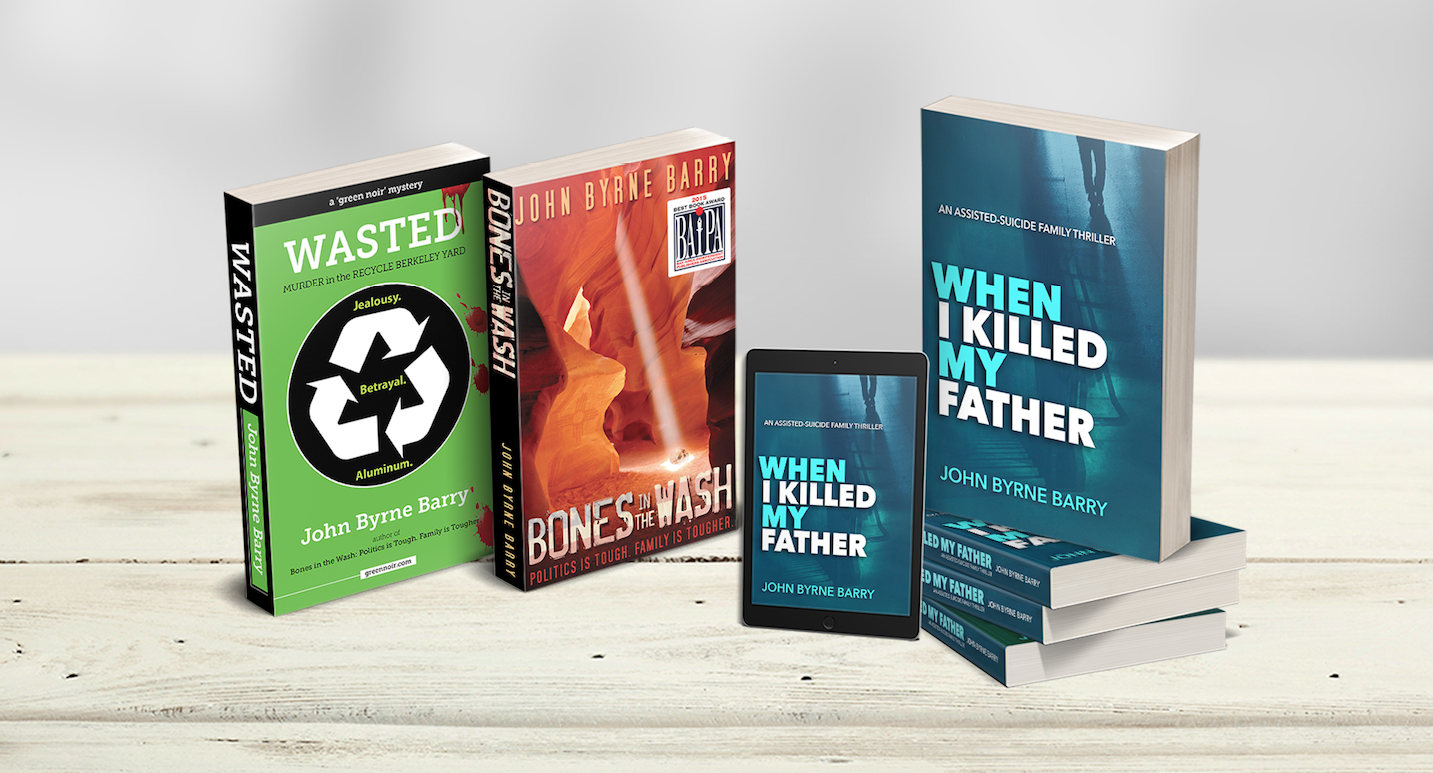
Isn’t it curious that we watch movies and read books full of bloody murders without batting an eyelash, while a novel about assisted suicide is considered controversial?
In November, I read a review on GoodReads about my new novel, When I Killed My Father: An Assisted-Suicide Family Thriller:
This indeed was a page turner. Although I really wouldn’t support or approve of any assisted suicide, this was really interesting to read about.
 I wrote the reviewer a note saying I was glad she enjoyed it, and asked — since she noted she didn’t support assisted suicide — if she assumed I did.
My intention, I wrote, was to tell a compelling and entertaining story, not advocate for any particular position. I deliberately avoided taking a stand on what should be legal or not.
But I do believe we should think and talk more about end-of-life questions — as individuals, families, and in our overall society.
When I wrote earlier murder mysteries, no one assumed I advocated murder. No reviewers felt the need to qualify their thoughts: “Of course I don’t approve of murder…”
I knew that this story, about a man ending his dying father’s life, would be controversial. And sure, the title is provocative. But I didn’t expect the blowback.
I hosted two book launch events this fall as part of Reimagine End of Life, a Bay Area “festival” exploring questions about life and death. I titled my event, “Why I Wrote an Assisted-Suicide Family Thriller,” and billed it as one part book reading and one part conversation about end-of-life concerns, such as family decisions, dementia and dying.
One event was in my neighborhood, at the Tam Valley Cabin on Tennessee Valley Road, where I’ve volunteered for five summers at the Creekside Fridays concerts. I asked the woman in charge if our local park department might co-sponsor the book event.
She said they were too busy in October with the Haunted House and other activities, and also, that it was a touchy subject. She wasn’t sure what she felt about it.
Fair enough. But the department produces a murder mystery dinner theater every year, and no one questions that for being too touchy.
And there’s the difference. The murder mysteries are full of jokes and pratfalls, meant to entertain. They’re a comic variation on those shoot-em-up action films where bodies are dropping everywhere, or the TV cop shows that invariably include a gunfight that takes out all the bad guys. Afterwards, the heroes go out drinking and tell jokes.
All that is make-believe. In our real world, killing someone or just seeing someone die is a ghastly event. If your parent or other loved one is sick and suffering — lingering before death — it is worse yet. So though I called my book a thriller, paced it accordingly, and aimed to be as entertaining as the Tam Valley murder mysteries, I wanted it to be more than that. If it makes people uncomfortable, maybe I got it right.



Recent Comments